


HRC52: Statement of Lithuania at the High Level Segment
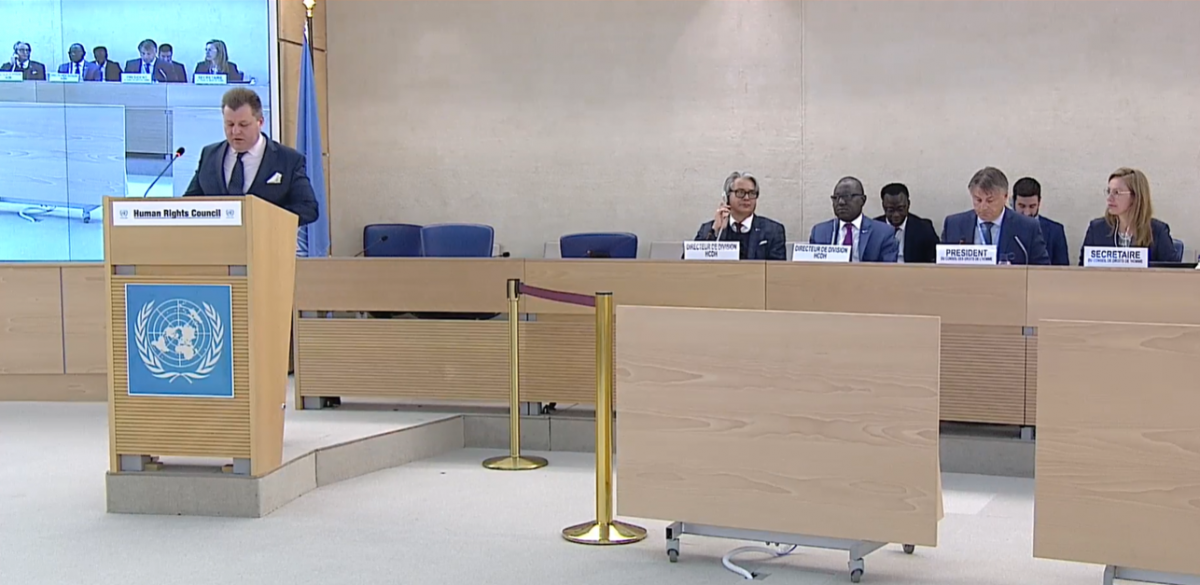
1 March 2023 High-Level Segment of the 52nd Session of the United Nation Human Rights Council Statement by the Vice-Minister of Foreign Affairs of the Republic of Lithuania Dr. Mantas Adomėnas
Mr. President,
Excellences,
Distinguished colleagues,
Lithuania has always been committed to upholding the universality, indivisibility, interdependence of all human rights and promotion of democratic values. Since becoming a member of the Human Rights Council last January, Lithuania has striven to ensure that our collective efforts are devoted towards the future where no one is left behind and no human right is ignored. We saw a clear imperative to support freedoms of expression, of peaceful assembly and association, as well as of religion and belief in every society. We envisaged working together towards creating a safe environment for human rights defenders, journalists and civil society activists online and offline, protecting the rights of the child, persons with disabilities, and promoting gender equality.
This year marks the 75th anniversary of the Universal Declaration of Human Rights, 30th anniversary of the Vienna Declaration and other important commemorations of human rights-related documents. These anniversaries signify that the entire international community has decades ago agreed on fundamental values and decided to engage in effective multilateralism, founded on rules-based international order and respect for human rights, democracy, and the rule of law.
Yet it is a different anniversary that stands out today. One year ago, on the 24th of February last year, Russia, aided by its accomplice Belarus, started an unprovoked, unjustified, illegal, and brutal war of aggression against Ukraine. This egregious act of disregard for the imperatives of peace, international rules-based order, and the outrageous disdain for fundamental human rights that followed set back by decades the implementation of the international community’s commitments to protect and promote human rights and freedoms. It also calls into question the viability of our system of multilateral organizations which singularly failed to prevent the outbreak of the greatest war in Europe since the World War Two.
The international community has been reduced to watching, more or less helplessly, as the crime of aggression was immediately followed by atrocity crimes and other large-scale systematic violations of international law in total disregard for the core UN Charter principles, international human rights and international humanitarian law by none other than a Permanent Member of the UN Security Council, supposed to be a pillar upholding the international order.
We have witnessed wide-scale destruction of cities and critical infrastructure, mass-killings of civilians and deliberate attacks on civilian infrastructure causing mass casualties, forcible transfers of Ukrainians to Russia, abductions and illegal adoptions of Ukrainian children, abuse of prisoners of war, torture, and sexual violence.
The Russian invasion of Ukraine caused a humanitarian catastrophe with far reaching consequences across the globe, including the global food security crisis, risks posed to nuclear safety, crises in energy and finance sectors, as well as threats to environment and the preservation of cultural heritage. These are all direct outcomes of Russia’s aggression, and they inevitably hinder global development and enjoyment of economic, social and cultural rights in every region of the world, especially in the developing countries. People in most vulnerable situations are being pushed into further poverty and suffering.
Quousque tandem abuteris, Russia, patientia nostra? How long will these high crimes against humanity will go unpunished? We, as the international community, have a grave collective responsibility to fight impunity in order to stop the ongoing violations of international law and to prevent their occurrence in the future. It is absolutely crucial to ensure full accountability for the crimes committed by Russia and its accomplices. Thus, we strongly believe that the Special International Tribunal has to be established to complement the role of the International Criminal Court in adjudicating the crime of aggression.
Excellences,
We are convinced that there is a close link between internal repressions and external aggression, between autocracy and disregard of other nations’ rights. We have a number of acute examples in our own neighbourhood. The constantly worsening human rights situation in Russia – systematic crackdown on civil society, human rights defenders, independent media, political opposition, and persons belonging to minorities – created a political environment in which outright military aggression could proceed unchecked. International attention to the worsening human rights situation in Russia should remain high on our agenda and we will support the efforts of the Special Rapporteur to shed more light on human rights violations there.
Belarus is another example of how strangling democracy allowed an autocratic, illegitimate leader to supress civil society, brutally repress any political dissent and turn a country and its people into accomplices of an imperialist aggressor.
There can be no justification whatsoever for politically motivated persecution, transnational repression and reprisals, arbitrary arrests and detentions, torture and killings. Therefore, we should all be extremely concerned whenever we see democratic backsliding, whenever we see efforts by some countries to restrict the right to freedom of expression, of peaceful assembly and association, and attempts to recreate paralyzing climate of fear closely resembling the totalitarian regimes of the past. By engaging with human rights defenders, NGOs, civil society, and promoting responsive and inclusive decision-making processes we should be able to react in a timely and effective manner to violations of human rights, wherever they may occur.
Today, the international community faces profound challenges. Yet it also demonstrates significant solidarity, acting in response to multiple crises. We responded immediately to the consequences of the devastating earthquakes in Türkiye and Syria. We continue showing solidarity to the people bravely standing up for their rights in Iran. We support the fight of women and girls of Afghanistan for their basic rights. However, we have to redouble our efforts to respond to human rights threats posed by climate change. We must strengthen our efforts to fight gender stereotypes, systemic discrimination, and gender-based violence. We must ensure that all groups of society are meaningfully represented and included in decision-making processes.
Mr. President,
Distinguished colleagues,
It is our collective responsibility to restore the rules-based international order by recommitting to the UN Charter, human rights, democratic values, and the rule of law. Lithuania will use all opportunities to actively promote rules-based international order, multilateralism and accountability. Only by genuinely working together we can ensure that the Universal Declaration of Human Rights applies to everyone without exception and that no one is left behind.
I thank you.
