Ministras L.Linkevičius skaitė kalbą JT Žmogaus teisių tarybos Aukšto lygio segmente
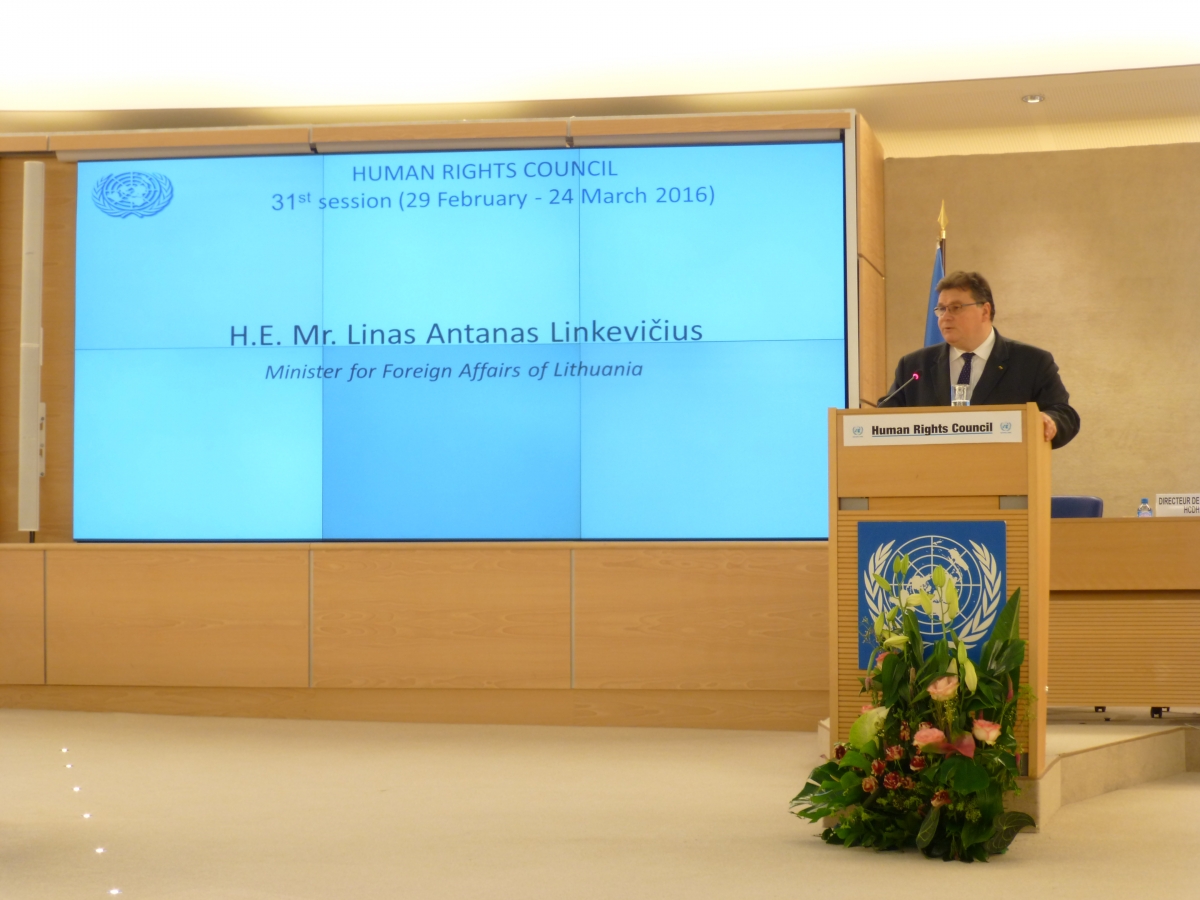
Lietuvos užsienio reikalų ministras Linas Linkevičius vasario 29 dieną Jungtinių Tautų (JT) Žmogaus teisių tarybos aukšto lygio susitikime kalbėjo apie regionines žmogaus teisių situacijas, žurnalistų saugumą, pažymėjo Tarptautinio ekonominių, socialinių ir kultūrinių teisių paktų penkiasdešimtą jubiliejų.
Kalbėdamas apie žmogaus teisių padėtį Ukrainoje, ministras pabrėžė, jog separatistų kontroliuojamose teritorijose vykdomi rimti žmogaus teisių pažeidimai. Jis paragino JT Vyriausiąjį žmogaus teisių komisarą ir JT Žmogaus teisių stebėjimo misiją Ukrainoje tęsti savo darbą, siekiant užtikrinti, kad kaltininkai būtų teisiami. L. Linkevičius taip pat paragino Rusiją įsileisti tarptautinius stebėtojus, atstovaujančius įvairius žmogaus teisių organus, į nelegaliai okupuotą Krymo teritoriją įvertinti mažumų ir ypač Krymo totorių teisių pažeidimus.
Ministras išreiškė susirūpinimą dėl žmogaus teisių bei humanitarinės padėties Sirijoje. Ministras pabrėžė, jog žmogaus teisių pažeidimus Sirijoje vykdo ne tik teroristinės grupuotės, bet ir dabartinė Sirijos valdžia. Ministras išreiškė viltį, kad bus pasiektas progresas derybose ir rastas politinis krizės sprendimas.
L. Linkevičius taip pat priminė, jog vien per šių metų du mėnesius žuvo 8 žurnalistai, o 154 yra įkalinti. Jis pažymėjo, kad šiandien kariaujama ne tik ginklais, bet ir tyčine dezinformacija, propaganda bei žiniasklaidos suvaržymais, todėl ypatingai svarbu užtikrinti teisinę žurnalistų apsaugą bei nusikaltimų prieš žurnalistus atskaitomybę. „Būdama JT Saugumo Tarybos nenuolatine nare praėjusių metų gegužę Lietuva ėmėsi žurnalistų saugumo klausimo bei 2006 m. JT rezoliucijos atnaujinimo, siekiant atspindėti šiandienes realijas. Lietuva ir toliau gins žiniasklaidos laisvę ir žurnalistų saugumą bei sieks saugios aplinkos pilietinės visuomenės nepriklausomai veiklai.“
Žmogaus teisių taryba yra pagrindinė JT žmogaus teisių apsaugos institucija, įsteigta 2006 metais. Pagrindinė jos funkcija – skatinti visuotinę pagarbą žmogaus teisių ir laisvių apsaugai, reaguoti į žmogaus teisių pažeidimus ir teikti dėl jų rekomendacijas. Lietuva JT Žmogaus teisių taryboje turi šalies stebėtojos statusą.
ADDRESS BY H.E. MR. LINAS LINKEVIČIUS
MINISTER OF FOREIGN AFFAIRS OF THE REPUBLIC OF LITHUANIA
TO THE 31st SESSION OF THE
UNITED NATIONS HUMAN RIGHTS COUNCIL
GENEVA, 29 FEBRUARY/1 MARCH 2016
Mr President,
Mr High Commissioner,
Ministers,
Ambassadors,
Excellencies,
Ladies and Gentlemen,
It is my great honour and privilege to address the Human Rights Council, the main body within the UN’s human rights pillar. I am particularly delighted to give a speech at this forum, whereas the year of 2016 marks its 10th anniversary, which is an important momentum for us all to take stock and discuss new and emerging human rights challenges in the Council’s work.
This year also marks another major anniversary: the 50th anniversary of the International Covenants on Civil and Political Rights and on Economic, Social and Cultural Rights – the two landmark treaties, which shaped the concept of international human rights. While the Covenants were created after WWII with a view to ensure a more peaceful and prosperous world, today still much remains to be done to achieve their effective implementation.
Ladies and gentlemen,
Fifty years since the adoption of the Covenants, the international community experiences extremely difficult times, marked by unprecedented scale of crises, threatened by warfare and terror.
Soon we will start counting the sixth year of the atrocities committed in Syria. Atrocities which are committed not only by terrorist groups such as Daesh but also by the current Syrian authorities. Civilian population continue to suffer from extreme violence, humanitarian situation is not improving. We sincerely hope that political process which is slowly taking place will be advanced as we all know very well that there is no military, nor humanitarian solution to this crisis only the political one.
For nearly two years now, Ukraine has been suffering from a conflict initiated under false pretexts and supported by an aggressive campaign of propaganda and hate. Conflict in Ukraine has already left over 9,000 dead, more than 20,000 injured, over 1.5 million uprooted from their homes within Ukraine and another 1 million forced to flee abroad. Tangible peace can be achieved only through the full implementation of the Minsk agreements. The lack of effective protection for human rights in the areas controlled by separatists has left people vulnerable to serious human rights abuses and violations. We have to continue to fight the lawlessness and impunity in those areas, and we must work to ensure that the perpetrators will one day be brought to justice. Therefore, the Office of the United Nations High Commissioner for Human Rights and the United Nations Human Rights Monitoring Mission in Ukraine should continue their much appreciated work and reporting. Moreover, we call on Russia to allow the access of the international monitors representing various human rights bodies to illegally occupied Crimea to assess the human rights situation of minorities and in particular the Crimean Tatars.
Ladies and gentlemen,
Journalists, media workers, bloggers who help us satisfy the inherent thirst for information continue to die and being imprisoned even in peace times across a number of countries around the world. This year just in two months 8 journalists were killed and 154 remain imprisoned. Today wars are fought not only by means of equipment and weaponry, but also through deliberate disinformation, propaganda, and media restrictions. Over the last decade, United Nations, including Human Rights Council, General Assembly and Security Council, have contributed to develop a legal framework for the protection of journalists and ensuring accountability for crimes against them. However, as better norms are created, the gap between those norms and implementation remains at times abysmal. Therefore, Lithuania took up the subject of protection of journalists in armed conflict at the Security Council last May, and sought to update the landmark resolution of 2006 and reflect new realities on the ground. My country will continue to speak in favor of media freedom and safety of journalists, we will be further advocating for a safe and enabling environment for civil society to perform their work independently and without undue interference.
Ladies and Gentlemen,
10 years after the creation of the Human Rights Council, we witness the inability of the international community to act in the face of mounting human rights violations. Therefore prevention of human rights violations have to remain utmost important. The proper use and strengthening early warning mechanisms, as well as improved coordination among the various actors on the ground, are some of the fundamental tools of prevention. We welcome the Secretary-General’s Human Rights Up Front initiative and the concept of Responsibility to Protect (R2P). At the same time we believe that more has to be done in shifting the focus from response to prevention in the Council’s work. The Council has a potential to play a more effective role in preventing gross and systematic violations and we, the states, need to engage in a more in-depth discussion on development of appropriate tools.
Mr. President,
My country stands ready to cooperate in strengthening the Human Rights Council, to which we will be running for election for the term 2022-2024. Lithuanians know what it means to live when human rights and democracy are denied. Therefore now we will staunchly defend fundamental rights, freedom and peace to everyone in this world.
I thank you, Mr. President.